Daymaker - a person who performs acts of kindness with the intention of making the world a better place.
~ David Wagner
, author of Life as a Daymaker; how to change the world by making someone's day ~

DayMaker - any thought, word, or deed that spreads happiness, compassion, or fruitful ideas.
~ Annis Cassells ~
Showing posts with label hiking. Show all posts

Monday, July 31, 2017

Back to Basics

The Chateau at Oregon Caves
Pings, chimes, catchy tunes, and wonky noises – our days are filled with constant audible notifications. Vibrations from our phones, Facebook, email, and calendars alert us, interrupt concentration and prod us to do something or go somewhere. We are always in demand. There’s a cure for that.

Recently, Judy and I experienced several days of peace and quiet, time off the grid. For our annual getaway, the “birthday jaunt,” we visited Oregon Caves National Monument and Preserve. 

This slice of tranquility sits in the Siskiyous southeast of Cave Junction at the top of a 45-minute, breath-catching, great-for-motorcycling road. As the ranger said, “It’s a commitment.” Not just a joy ride. Well, unless you’re actually on a motorcycle.

Wi-fi is not available to visitors. Cell phone service is spotty. A sign on the desk at the Chateau reads: "The worst cell phone service in the world delivers the best nature service in the world." Since we'd be using our phones for photography, we put them in Airplane mode. I even silenced mine so I wouldn’t hear the photo click.

Except when Ranger Hope Turner spoke, or someone our group asked questions, it was silent inside the cool caves, which have a constant 44 F temperature. To give us the full effect, she turned out all the lights at one point, and we were suspended in nothingness. No sound, no light. She told us about the cave insects. It was fascinating, and a bit creepy, to think of “life” going on, and thriving, in total darkness.
Covered bridge on No Name Trail

Judy and I did two surface hikes, the No Name and the Big Tree Loop trails. They took us through aromatic fir forests with groves of madrone, moss-covered rocks, fallen tree stumps, lacy ferns, and gurgling streams. Many folks were on the mountain, but we had the trails to ourselves. Nature’s sounds engulfed and delighted us -- the rush of the River Styx, the creeks, and the waterfalls. The birds’ calls and songs, and scampering noises of small animals on the forest floor surrounded us.


On the Big Tree Loop Trail
Deer families of three and four emerged at night, nibbling their way around the edges of areas that had a short time before been populated with park visitors.


In the Chateau, the spacious guest rooms have no televisions or telephones. We slept two nights under hand-made quilts and down comforters, our windows open to the fresh mountain air and the sound of the waterfall across the parking area.


We observed scenes that threw back to the early days of the 1930s when the Chateau was built. Travelers came and went or sat in period furniture in the grand lobby, reading, writing, or conversing over drinks. The sound of the baby grand piano brought back many memories as a young man played renditions of standards and show tunes during the afternoon.

Coffee shop specialty
In the game room, children and parents became immersed in old-fashioned board games and older kids read to their younger brothers and sisters. Muted dining room music featured songs from the 30s and 40s. The coffee shop with its long counters and red-upholstered swivel stools reflected a time when life was slower with fewer interruptions.

Before departing we took a last walk for a short distance on the No Name Trail to capture some photos in a different light. Feeling renewed, we savored the view of the neighboring mountains and the sounds of nature that we’d been part of for our time at Oregon Caves. Then made our way down the twisty mountain road and back to civilization, our phones still silenced.

~ xoA ~


Monday, March 24, 2014

Advice from a Volcano


I’ve been away, on vacation on the island of Hawai’i.
 While there, Judy and I hiked in Volcanoes National Park. One day, our journey took us through the lava tube, over a rugged path on the crater rim, and down onto and across the floor of the caldera, where we warmed our hands at the steam vents. 


Our second day, we drove to the end of the crater road and stood atop the lava where the newest lava flow crossed on its way to the ocean a few years ago. 

 Along that drive, the site of ancient petroglyphs beckoned to us, so we stopped for a look at these revered artifacts.

 Back in the gift shop after viewing a thrilling volcano video, the words of Ilan Shamir caught my attention. “Advice from a Volcano” felt like a DayMaker-kinda’ message. So here you are. With love and aloha. xoA
 
Advice from a Volcano

Stay Active
Keep your Inner Fire Burning
It’s OK to Let off Steam
Go with the Flow
Be Uplifting
It’s All a Matter of Time
Have a Blast!

Pele (Original hanging in the Jagger Museum)

Friday, December 13, 2013

Z is for Zion National Park


As we approached the entrance of Zion National Park, its majesty rose to greet us.  The massive sandstone cliffs and the valley’s fall landscape inspired lots of photography and exploration. Zion was the first on our week-long journey around Utah, taking in as many national parks and monuments as time allowed. Close to Las Vegas, its southwest location made Zion, Utah’s first national park, a perfect beginning.

We pulled over for a photo shoot at the park entrance sign, then made our way to the Visitors’ Center to learn about visiting and hiking in the park. No cars are allowed on the scenic drive from March to November, so we would need to take the shuttle and hop off at different stops along the route. Buses ran frequently, and we had the freedom to see the sights and to take photographs as much as we wanted. 

Our strategy was to take the shuttle to the furthest stop, the Temple of Sinawava, and see what we could there. Then we would make the trip back, taking the shuttle or hiking to the next stop. That let us see a good deal of the park, get some exercise, and soak up the grandeur of Zion.


One favorite spot was Weeping Rock, a popular park feature with a trail that ascends to a rock alcove with dripping springs and hanging gardens. Part of the trail had been closed in September after a rock slide made it unsafe. It had reopened, but from the shuttle stop, we and our fellow nature lovers could make the 98-foot climb.


 As wondrous as is Mother Nature’s role is making Zion National Park, I also have to salute the visionary first National Parks Service Director, Stephen T. Mather. He set out to develop visitor access to the natural wonders of the national park system. With Mather’s promotion and dedication, by 1930 hard-working engineering and construction crews had built the Zion-Mt. Carmel Highway and Tunnel, making Zion, Bryce Canyon, and the Grand Canyon accessible by automobile. 
Photo from NPS website


The 25-mile road was a joint effort between the National Park Service, the state of Utah, and the Bureau of Public Roads. Most challenging was creating the 1.1-mile long tunnel that would connect the new road from the east with the winding road to the west. The tunnel would have to be carved through the heart of the sandstone cliffs. This remarkable feat of engineering and construction is now listed in the National Register of Historic Places.  In 2012, the American Society of Civil Engineers named the road and Tunnel a Historic Civil Engineering Landmark.

Though we spent only a day and a half in Zion, it was a fitting intro to the variety of Utah landforms and national parks. Navigating the Zion-Mt. Carmel Highway and passing through the magnificent Tunnel were part of the magic.
 ~ xoA ~

Tuesday, November 12, 2013

R is for Red Rock Canyon


The family that hikes together ...

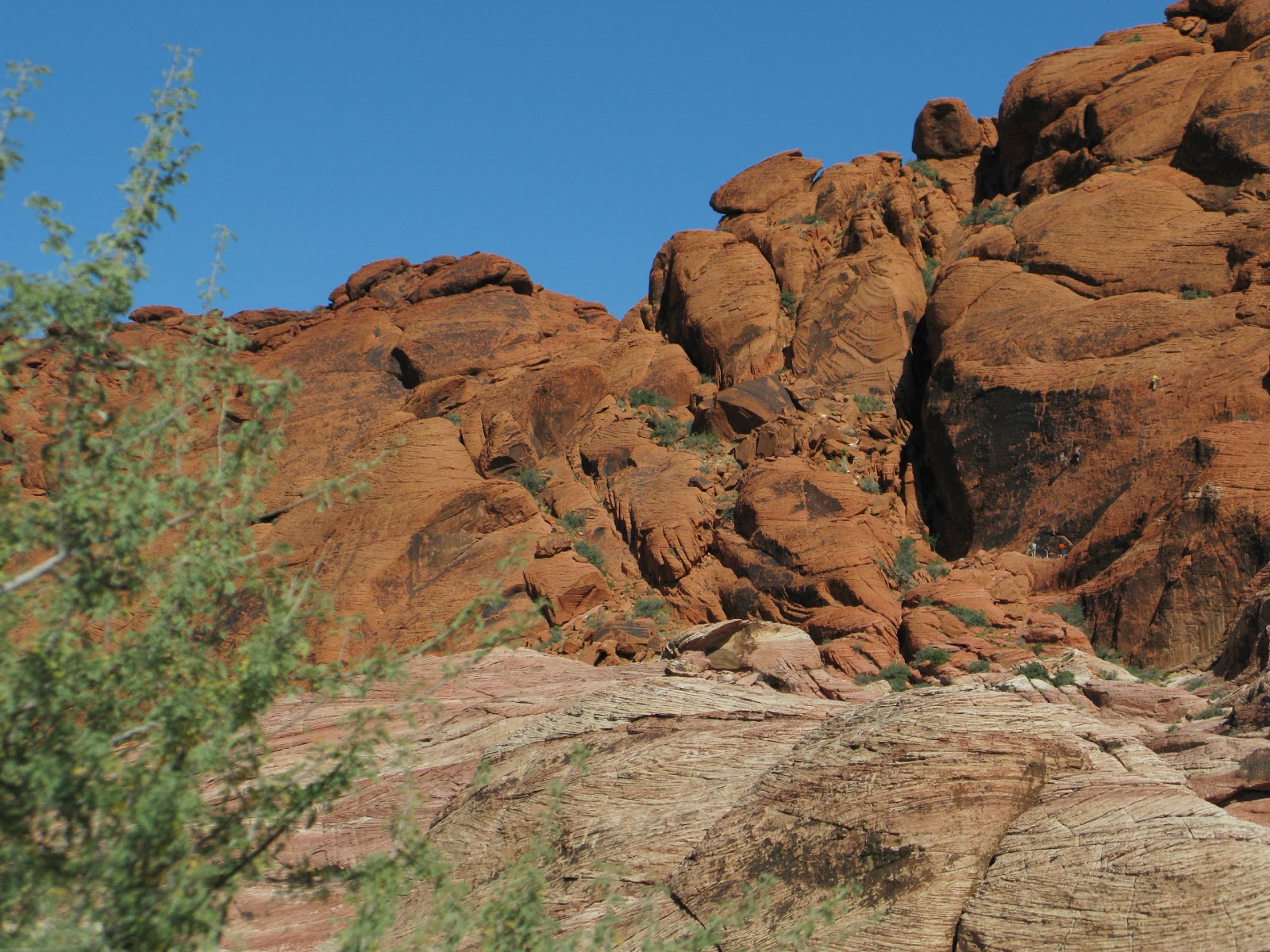
Red Rock Canyon, just 17 miles west of the Las Vegas Strip was the site of our traditional family reunion hike in 2010. None of us knew it existed until a friend mentioned going horseback riding there. It was perfect for us. 

We’d come together from the rolling hills of Virginia, the bustle of Phoenix, Los Angeles, Bakersfield, and Reno to commune with family members who had last been together in 2007. The famed red rock stood out against the azure sky, and we admired the beauty of the place. A group that contained artists and writers as well as lovers of the outdoors, we were enthralled. 


 Zooming in with our photo lenses, we were able to capture climbers that were rappelling off the firey red rock.


Known also for serving as home to different Native American tribes in the early days, Red Rock Canyon proved to be a cultural resource. One outstanding thing was the petroglyphs that stand in the Red Spring area. There are two different types of rock art. One is petroglyphs, which were carved or pecked into the rock's surface. The other is pictographs, which were painted on the rock.


In Red Rock Canyon, the most common type of rock art is petroglyphs. The dark "desert varnish" over light-colored limestone makes a perfect medium for petroglyphs. The Red Spring area is home to a wide variety of styles of petroglyphs.

Other evidence of the presence of Native Americans are the "tools and trash of everyday living.  Broken pots and stone tools are pieces of the puzzle that, when put together, tell the story of ancient ways of life and human adaptation to the desert."


With a full half-dozen of us shooting photos, we got some beautiful shots of the area. The magnificent rock formations and fauna showed us a side of Las Vegas that we had never even considered. 

 
We spent only a few hours at Red Rock Canyon and only scratched the surface of the myriad activities there. But the grandeur of the views as we hiked along made a lasting impression.

~ xoA ~

Wednesday, June 12, 2013

20 Loves, Part 7: Hiking


A walk in the park invigorates, takes one outside a gym for exercise, allows for relaxation. But a hike takes the great outdoors to a whole different level. A hike is an adventure of discovery. What’s up the next ridge or around the curve? Which of these bark-lined paths is the real trail? What historical artifacts will we find?
 
Last weekend, Judy and I joined Oregon’s South Coast Striders for their bi-monthly hike. Eager to investigate nearby trails that we’d never hiked, we gathered our day pack, water, snacks, walking sticks, and knee braces. The day, sunny with moderate temperatures in town, turned cold and windy as we rendezvoused at the Point Arago starting place. We layered up with jackets and vests, happily finding gloves in our pockets.

Soon, we were off with a group of 25 or 30 others over a new section that had been recently added, reconfiguring the trail into a loop. Our leader took us off the main path at one point to show us a World War II bunker that stood abandoned and roofless under huge trees in what had been goat fields seventy years ago. He told us an account of the bunker’s purpose and layout from a local man who’d been an Army corporal back then. Turns out, he was someone we knew.


One of the things I enjoy about hiking is going out to new territory, meeting the challenges each place presents, and testing myself. Can I find my way? Do I have the stamina for this hike? 

Hiking is one way to get up close and personal with nature. You’re immersed, touching, seeing, smelling, listening, even tasting. All senses are heightened, standing alert, doing exactly the jobs for which our long-ago ancestors used them.

Most planned hikes are rated: easy, moderate, or difficult. At national and state parks, there are often maps that show the trails and the topography. Thus, hikers can choose the perfect jaunt for their ability and endurance.

Four years ago, Judy and I made a tour of the National Parks and Monuments of Utah. We began with Zion then moved on to Bryce Canyon. Before the week was finished, we’d hiked Canyonlands, Arches, and Capitol Reef. The varied terrain and landscapes within a relatively small area fascinated us. At one park, I experienced my first time climbing over rocks, having to note the stone cairns that marked the trail since there was no bark path to follow. The vistas provided us a view of our great land and showed us some of what the early settlers and pioneers traversed.
Canyonlands National Park

Hiking gives me a feeling of freedom and the wonder of nature. It shows me that I can manage in a natural setting and feeds my need to discover and learn new things. So many trails; so little time.

Do you enjoy hiking? What’s your favorite hike or trail? Have you read Bill Bryson's A Walk in the Woods or Cheryl Strayed's Wild?

~ xoA ~