
Machu Picchu, the
Inca ruins in the Peruvian Andes, fascinated me when I taught 7th
grade social studies. So, in 2003, when a travel
catalog advertising an 18-day tour that combined the Galapagos Islands, the
Amazon River, and Machu Picchu, Judy and I were on board.
The Incas lived
and thrived there for approximately 50-70 years in the 1400-1500s. There are
many theories on what may have happened to the people. Since very few artifacts
were found, some scholars say that the Incas abandoned Machu Picchu. Common
knowledge of its existence came when U.S. archaeologist Hiram Bingham found his
way there in 1911.
 Getting there was
an adventure. We’d stayed in Cusco for several days, taking day trips and
acclimating to the high elevation. From there, traveling by bus, we drove over
passes up to 12,500 ft., eventually dropping into the Sacred Valley along the
Urubamba River. As often happens on an Overseas Adventure Travel tour, we
stopped at a local market so we could walk among the native people.
Getting there was
an adventure. We’d stayed in Cusco for several days, taking day trips and
acclimating to the high elevation. From there, traveling by bus, we drove over
passes up to 12,500 ft., eventually dropping into the Sacred Valley along the
Urubamba River. As often happens on an Overseas Adventure Travel tour, we
stopped at a local market so we could walk among the native people. Soon we boarded a
train that traveled up the Urubamba River gorge. Seated on the river side, we
had a terrific view of the noisy, churning, brown water. This swift,
boulder-filled river has Class 4 to Class 6+ rapids. Soon we arrived at the
small town of Aguas Caliente, which sits right on the river and is the gateway
to Machu Picchu, a few miles away.
Soon we boarded a
train that traveled up the Urubamba River gorge. Seated on the river side, we
had a terrific view of the noisy, churning, brown water. This swift,
boulder-filled river has Class 4 to Class 6+ rapids. Soon we arrived at the
small town of Aguas Caliente, which sits right on the river and is the gateway
to Machu Picchu, a few miles away.
After lunch, the
30-minute shuttle bus ride stood us on our heads as we negotiated the hairpin
curves of a stripe of hard-packed dirt that would deliver us to our
much-anticipated Machu Picchu.
Unfolding before
us as we stood at the entry gate was a breathtaking view of an entire Inca
City. Many walls remained, or had been reconstructed, so only the thatched
roofs needed to be imagined.
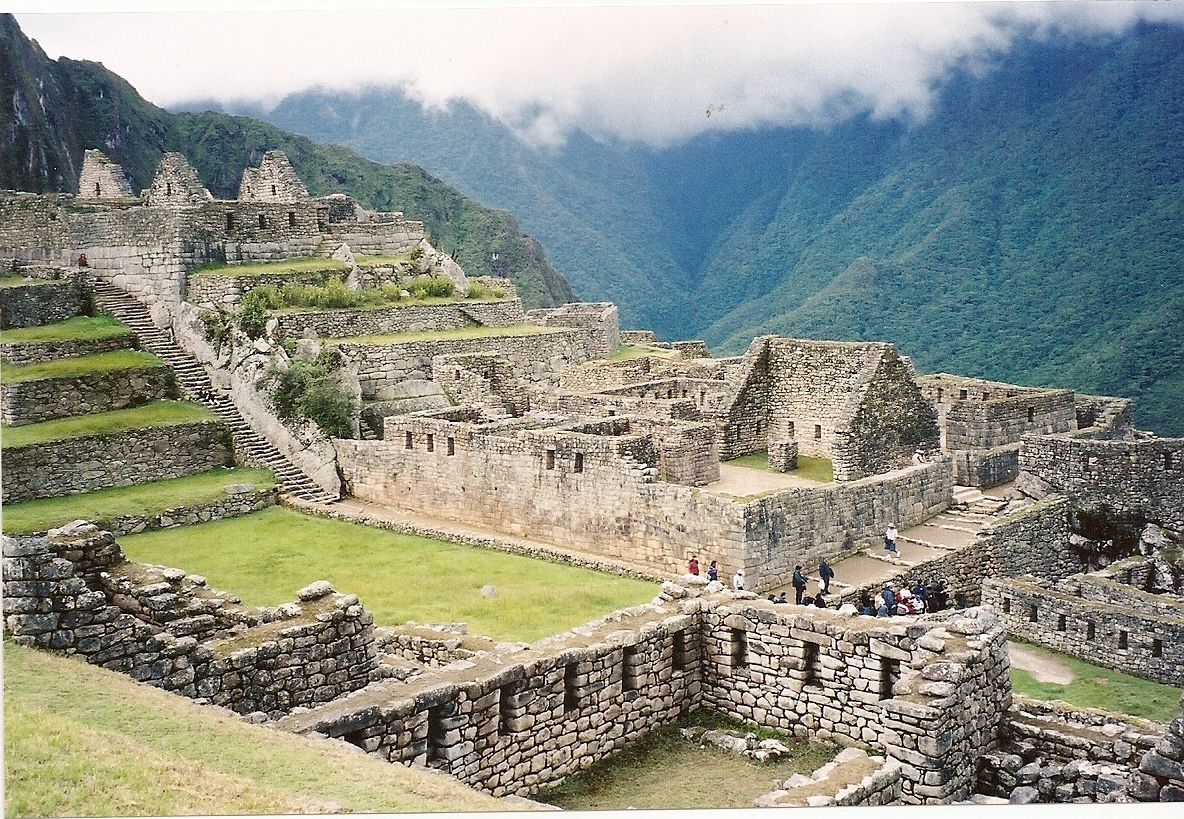
It was the rainy
season, which colored the landscaped terraces and plazas shades of vibrant
greens. We looked out over the expanse of the city to take in the areas
designated as the agricultural section, the industrial district, the homes for
the commoners and those of nobility.
 Climbing up to
one of the restored huts, thought to have served as a guardhouse, we had an
outstanding view, and I felt the presence of the Incas who had lived and worked
there.
Climbing up to
one of the restored huts, thought to have served as a guardhouse, we had an
outstanding view, and I felt the presence of the Incas who had lived and worked
there.
We explored the
Temple of the Sun and saw the carved live rock, which, according to the sun´s
position and the shadows the rock cast, told the Incas when it was the time to
plant their crops.
One thing written
up in the literature that we wanted to see was the "jail." But, our
guide told us Hiram Bingham may have called it a jail, but the Incas had no
need for such a thing. They had three basic rules to live by: don´t be a thief,
don´t be a liar, and don´t be lazy. Anyone who broke any of these rules was
punished by death.
Machu Picchu is
one of the world´s wonders that begs to be experienced firsthand. The full
impact of this place is a feast for all the senses. But, do make sure you’re in
good physical condition so you can enjoy yourself while hiking and climbing in
the area.
~ xoA ~


